
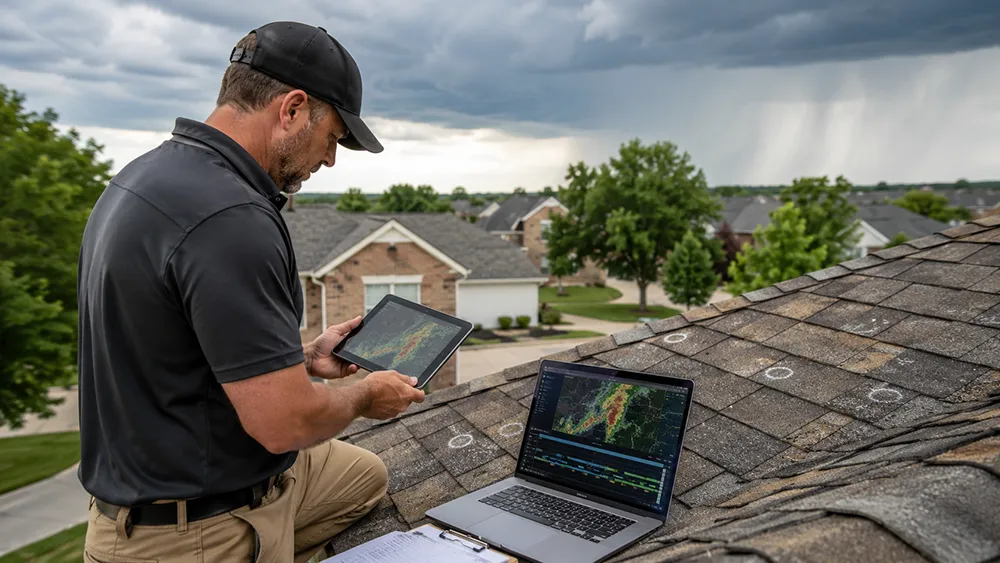
When a roof may have been affected by a storm, identifying the right weather event is not always simple.
A homeowner may remember that “there was hail sometime in May.” A roofer may find conditions consistent with storm exposure but need a better understanding of when severe weather occurred. A public adjuster may be comparing inspection findings, claim records, and weather evidence to determine which dates deserve closer review.
Historical weather research can help narrow that process.
The key is to understand that a nearby hail report, a measured wind gust, a severe thunderstorm warning, and a radar-based swath are different types of evidence. None should automatically be treated as proof of what occurred at a specific roof.
Start With the Exact Property Address
Broad searches like “hail in Orlando” or “windstorm in Dallas” are often too general.
Severe weather can vary significantly across the same city or ZIP code. One neighborhood may experience large hail while another several miles away receives only rain and moderate wind.
Starting with the exact property lets you search outward from a fixed location.
An address-level historical weather search can help identify candidate storm dates before reviewing individual reports, warnings, station observations, and radar data.
For homeowners, that can help narrow down when a potentially significant event occurred.
For roofers, it can provide useful context before preparing a storm-related estimate.
For public adjusters, it can help organize an investigation around specific dates instead of a broad time range.
Check Nearby Hail Reports
Hail reports are one of the most useful starting points.
The National Weather Service receives storm reports from trained spotters, emergency managers, law enforcement, weather stations, and members of the public. These reports may document hail size at a particular location and time.
For example:
Hail size: 1.50 inches
Time: 4:37 p.m.
Distance: approximately 2.6 miles northwest of the property
That is useful evidence that hail was reported nearby.
But distance matters. A report of 1.50-inch hail several miles away does not automatically establish that the same size hail fell at the property.
For that reason, it is better to preserve the report accurately:
1.50-inch hail was reported approximately 2.6 miles northwest of the property.
An address-based hail history search can help identify nearby hail events and reports before deeper research begins.
Homeowners should look for whether hail reports were actually close to the property.
Roofers should compare report timing with the homeowner’s account and inspection findings.
Public adjusters should preserve the report’s source, time, distance, direction, and reported size.
Review Wind Reports Separately
Wind reports require the same care.
If a 65-mph gust was reported three miles from a property, the accurate statement is that a 65-mph gust was reported approximately three miles away.
That is different from saying the property experienced 65-mph winds.
Another important distinction is whether the wind was measured or estimated.
A measured gust generally comes from an instrument. An estimated gust may come from an observer’s assessment or other storm information.
Both can be useful, but they are not the same type of evidence.
Compare Reports With Weather-Station Measurements
Weather stations provide another important layer.
NOAA’s surface observing systems measure variables including wind speed, direction, and gusts. If a nearby station records a peak gust of 58 mph, that is an actual measurement at that station.
The limitation is location.
A 58-mph gust measured six miles away does not necessarily mean the same wind speed occurred at the property.
For homeowners, station data can help confirm that a strong wind event occurred nearby.
For roofers, it can add context to a storm-related estimate.
For public adjusters, the station’s distance from the property should remain part of the record.
Use Warnings to Reconstruct the Storm Timeline
National Weather Service warnings can help establish when severe weather approached or affected an area.
A Severe Thunderstorm Warning may include the warned area, expected hazards, storm movement, timing, and nearby communities.
If a property was inside a warning from 4:10 to 5:00 p.m., nearby hail was reported at 4:28 p.m., and a nearby station recorded its strongest gust at 4:35 p.m., those records begin to describe the same event.
A warning does not prove that every listed hazard occurred at every property inside the warning area, but it can provide useful timing and storm-track context.
Look at Hail Swaths, Not Just Individual Reports
Hail reports are point observations. Radar provides broader geographic coverage.
Radar-based hail products can estimate where hail-producing portions of a storm traveled. When mapped over time, these estimates are often described as hail swaths.
This matters because official hail reports are sparse.
If one hail report appears west of a property and another appears east of it, a radar-derived hail swath crossing the neighborhood can help show how the storm moved between those reports.
Still, a hail swath is not a measurement taken on the roof.
Its value is in answering a broader question:
Did radar indicate hail-producing conditions near or over the property during the event?
Wind Swaths Can Fill Gaps Between Stations
Wind has a similar issue.
Weather stations are fixed at specific locations, while thunderstorm winds can be highly localized.
Wind swaths and analyses may use combinations of measured observations, storm reports, radar information, meteorological analyses, and weather models to estimate how stronger winds were distributed across an area.
That can be useful when the strongest winds occur between observing stations.
Users should still distinguish between:
- Measured wind — recorded by an instrument.
- Reported wind — documented through a storm-reporting system.
- Estimated or modeled wind — derived through meteorological analysis.
StormAuditor explains its underlying sources and processing in its weather data methodology, which is the type of transparency worth looking for in any historical weather product.
Compare Multiple Possible Storm Dates
One of the most useful parts of historical research is discovering that there may be more than one plausible event.
For example:
March 19 — strong wind reports and a severe thunderstorm warning.
April 11 — nearby hail reports and a radar hail swath.
June 7 — stronger measured winds but limited hail evidence.
August 2 — another hail-producing storm crossing the area.
Weather records alone cannot tell you which event caused a particular roof condition.
But they can help identify which dates deserve closer review.
Homeowners can compare those dates against when they first noticed problems.
Roofers can compare them against inspection findings and prior work.
Public adjusters can compare them against claim documents, photographs, inspections, and repair history.
Build a Simple Storm Timeline
Once a promising date is identified, organize the records chronologically.
For example:
4:12 p.m. — Severe Thunderstorm Warning includes the property.
4:28 p.m. — 1.00-inch hail reported 3.4 miles west.
4:34 p.m. — Radar hail indications move toward the neighborhood.
4:41 p.m. — Nearby station records a 53-mph gust.
4:47 p.m. — 1.25-inch hail reported 2.7 miles east.
A timeline like this is often more useful than a folder full of unrelated screenshots because it shows how the event unfolded.
Weather Data Does Not Replace the Roof Inspection
Historical weather research and physical inspection answer different questions.
Weather data helps answer:
What weather occurred near this property, and when?
The inspection helps answer:
What condition is the roofing system in?
A homeowner should not assume that a nearby hail report proves roof damage.
A roofer should still rely on photographs, measurements, materials, codes, and estimating requirements.
A public adjuster should evaluate weather evidence alongside the broader claim record.
FAQ
Can a hail report prove that hail hit my roof?
Not by itself. A hail report documents what was reported at a specific location. The closer the report is to the property, and the more supporting radar or nearby reports exist, the more useful it may be for understanding the storm.
What is the difference between a hail report and a hail swath?
A hail report is a point observation at a specific place and time. A hail swath is a radar-based estimate showing the broader area where hail-producing conditions may have occurred.
Are wind reports always measured?
No. Some wind reports are measured by instruments, while others are estimated. The report source and qualifier should be checked whenever available.
Can weather data determine whether a roof was damaged?
Weather data can show what weather occurred near a property, but it does not replace a physical roof inspection or establish damage by itself.
Why should I check more than one possible storm date?
Storm-prone areas may experience several significant events in the same year. Comparing multiple dates helps avoid assuming that the first remembered or reported storm was necessarily the most relevant one.
What weather sources are most useful for researching a property?
A strong historical review may include nearby hail and wind reports, weather-station observations, National Weather Service warnings, radar-derived hail data, and broader wind analyses.
Who can benefit from address-level storm research?
Homeowners can use it to better understand past weather near their property. Roofers can use it for storm context before estimating. Public adjusters can use it to organize weather evidence around possible dates of loss.