
Most roofers don’t stop working when the sun goes down. When the last estimate is written, which is usually late at night after the crews have gone home and the phone calls have stopped, it is over. That’s because estimating by hand is slow, boring, and likely to make mistakes that cost real money.
But a new set of AI-powered tools is changing that. Roofers all over the country are learning how AI can help them get their estimates done much faster. This gives them more time to focus on growing their business instead of doing paperwork.
The Unseen Cost of Handwritten Estimates
A manual estimate usually takes two to three hours to complete. The roofer has to walk on the roof, measure things by hand, write down notes, put everything into software, figure out how much material is needed, add up the cost of labor, check for mistakes, format the proposal, and send it.
For a roofing company that does 15 to 20 estimates a week, that means 30 to 60 hours of work just for the paperwork. That’s almost the same amount of time as a full-time worker would spend on bidding.
As Roofing Contractor magazine has reported, slow estimating is one of the top reasons contractors lose bids to faster competitors. When a homeowner needs a repair, they want answers immediately. Delays can cost you the job before you’ve even submitted a proposal.
What AI Really Does
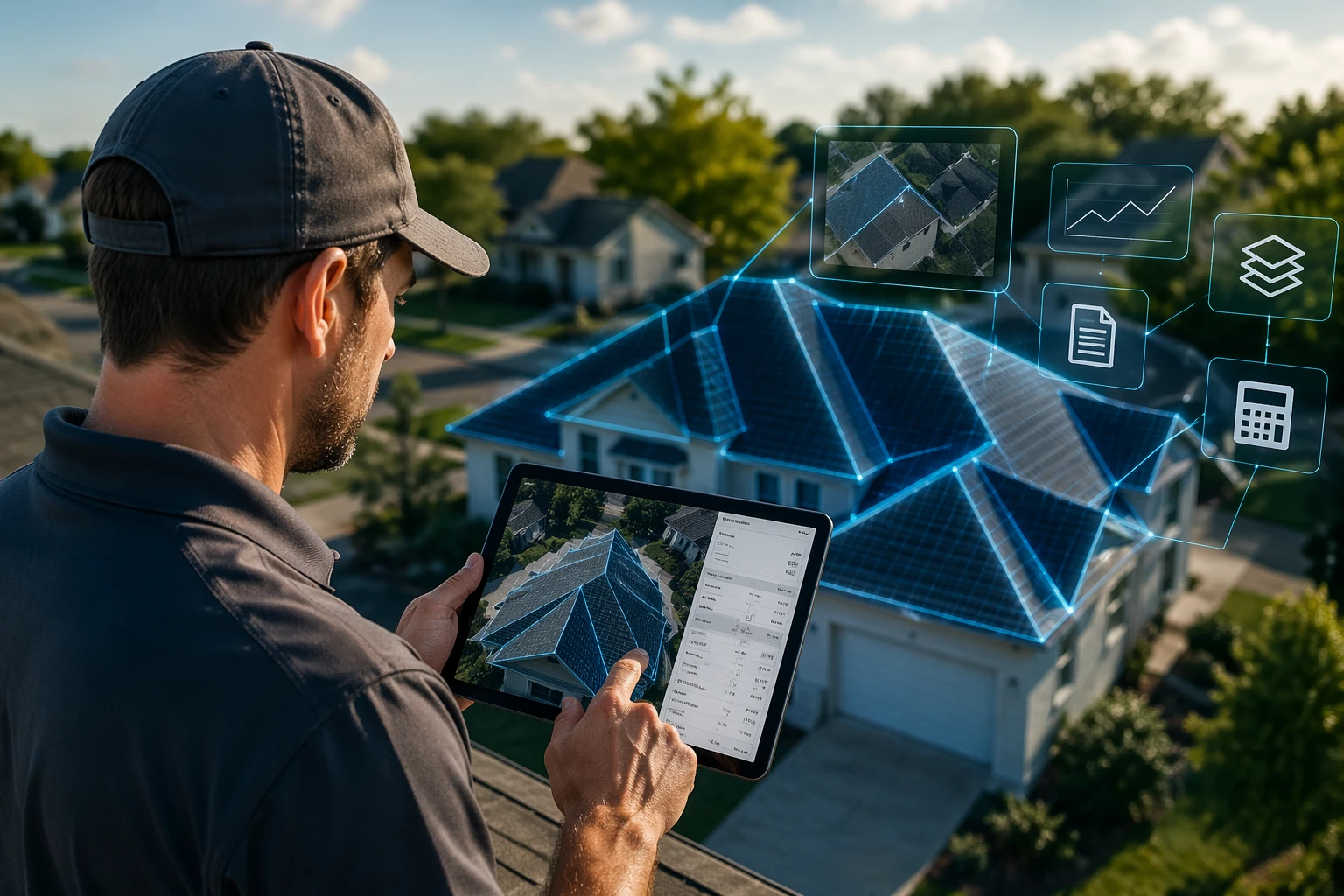
AI estimating tools look at satellite images, measurement reports, and historical data to make detailed estimates in minutes, not hours. The program finds roof planes, figures out how many square feet there are, and automatically finds slopes, valleys, hips, and edge details.
The estimate is made automatically in 90% of cases in three to five minutes. The contractor only needs to look it over, make some changes, and send it.
According to Constructech, AI-powered construction software is one of the fastest-growing parts of the industry, with adoption rates doubling every year. Contractors who use this technology have a big advantage over their rivals.
Real Results from a Roofing Company
A 12-person roofing company in Dallas tracked its numbers for 60 days before implementing AI estimating. Before AI, they completed 18 estimates per week with an average turnaround of 26 hours. Their close rate was 32%.
After implementing AI, they completed 34 estimates per week with a turnaround of just 4 hours. Their close rate went up to 41%. Most importantly, sales went up by 18% without hiring any new employees.
The National Roofing Contractors Association (NRCA) says that contractors who use estimating technology always get more bids and make more money.
Why More Estimates Mean More Money
You can bid on more jobs when you can make an estimate in 20 minutes instead of 2 hours. More bids give you more chances to win. And homeowners are less likely to sign with a competitor if the work gets done faster.
The math is simple. If you close 30% of your bids, doubling your estimate volume doubles your revenue potential—without adding a single crew member to your payroll.
Accuracy: AI vs. Human Estimators
One company tested 50 estimates comparing AI against an experienced human estimator. For material quantities, AI was accurate within 2% on average, compared to 6% for the human estimator. AI never rounds numbers, forgets waste factors, or transposes digits—all common human errors.
For labor estimates, after 20-30 jobs, AI predictions were consistently within 5% of actual hours. The system learns from completed projects, getting smarter over time.
Forbes has reported that AI-driven estimation tools are reducing costly errors across the construction industry, with some companies reporting error reductions of up to 90%.
The Integration Piece Everyone Forgets
AI estimating only reaches its full potential when it connects to your existing business systems. Real-time supplier pricing ensures material costs are always current. CRM integration auto-populates customer information. Accounting links feed actual job costs back into the AI to improve future estimates.
Without these connections, you’re still copying and pasting between four different systems. With them, the estimate flows seamlessly from satellite image to signed contract.
Addressing Common Concerns
“AI can’t handle complex roofs.” Advanced AI tools handle multiple roof planes, dormers, skylights, and even curved surfaces. You review and adjust the small percentage it can’t figure out. It’s still much faster than starting from scratch.
“Customers want in-person inspections.” AI doesn’t replace the site visit. It handles the math before you get there. You still walk the roof, verify measurements, and spot things AI can’t see—like rot or ventilation issues.
“What if AI makes a costly mistake?” You review every estimate before sending. Always. But also consider how often human estimator errors have cost you money.
Getting Started with AI Estimating
Most AI estimating tools offer free trials or demo periods. Setup typically takes just 2-3 hours, including connecting supplier pricing and customizing proposal templates. You’ll see time savings on your very first estimate.
For a complete breakdown of how AI estimating works, including real ROI calculations for small, medium, and large roofing companies, visit CompanySync’s detailed guide.
Final Thoughts
AI estimating isn’t about replacing your experienced estimators. It’s about giving them less time to figure things out. AI takes care of the boring math and data entry so that your team can focus on what they do best: selling, managing, and doing good work.
If you’re a contractor who does more than 50 jobs a year, it’s easy to see that hours saved turn into money made. The technology is ready. The question is whether you are.
And for homeowners looking for trusted roofing services, YICN Roofing continues to provide expert craftsmanship and honest guidance throughout Northeast Ohio.
FAQs
1. How does AI speed up roofing estimates?
AI automates measurements, calculations, and formatting, reducing estimate time from hours to just minutes.
2. Is AI estimating accurate enough for real projects?
Yes, AI tools often achieve accuracy within 2–5%, reducing common human errors like miscalculations and missed items.
3. Will AI replace human estimators?
No, AI supports estimators by handling repetitive tasks while humans review, adjust, and handle complex decisions.
4. Can AI handle complex roof designs?
Advanced AI tools can analyze multiple roof planes, slopes, and features, though final adjustments may still be needed.
5. Do roofers still need to inspect the property in person?
Yes, on-site inspections are essential for identifying issues like damage, ventilation problems, or structural concerns.
6. How much time can AI estimating really save?
Many contractors save 10+ hours per week by reducing manual estimating tasks.
7. Does using AI help win more jobs?
Yes, faster turnaround times and more accurate estimates can improve close rates and increase overall sales.
8. Is AI estimating expensive to implement?
Most tools offer affordable pricing or free trials, and the time savings often outweigh the initial cost.
9. What systems should AI estimating integrate with?
For best results, it should connect with CRM, supplier pricing, and accounting systems for a seamless workflow.
10. How quickly can a roofing company start using AI estimating?
Most companies can get set up in just a few hours and start seeing benefits immediately.